Welcome
Sights of Rotterdam is the starting point to discover Rotterdam, with both tourist highlights and practical information.
Rotterdam is the second-largest city in the Netherlands, home to Europe’s biggest port, and located just an hour from Amsterdam. Between the two cities lie Delft, The Hague, and Leiden. Head south and you’ll reach Belgium, with Antwerp also only an hour away from Rotterdam. The city itself is full of surprises and excitement, so be sure to spend time exploring Rotterdam and discovering everything it has to offer.
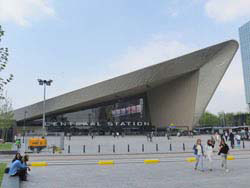 |
Many visitors begin their journey through Rotterdam at Central Station. Since 2014, the new station building has provided more space to accommodate larger numbers of travelers. The tip of its roof points toward the city centre, which is just a short walk away. At the front entrance of the station, you’ll also find a tourist information desk. | |||
| Coming from Central Station, you’ll see the Weena to your left, and about 600 meters further lies the Hofplein. This is a very busy traffic square with a fountain. (TIP: To the right at Weena 705, you’ll find a shop where you can rent bikes.) | 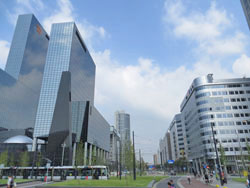 |
|||
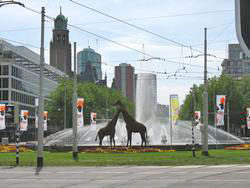 |
The Hofplein with Hofplein Fountain is at the moment being transformed from a busy traffic roundabout into a green city square, resembling a park, with completion expected by 2027–2028. Before the bombing of Rotterdam in 1940, the Hofplein was located a little further down the road where you find now artwork 'New Delftse Poort'. | |||
| This is the New Delftsche Poort (1993), an artwork inspired by the original Delftsche Poort built in 1764. The original was the only remaining city gate in Rotterdam, but it was destroyed during the German bombing of the city on 14 May 1940. | 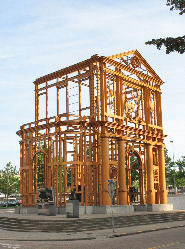 |
|||
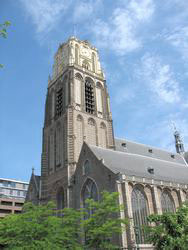 |
The Lawrence Church (Laurenskerk). The only remaining medieval structure in Rotterdam’s city centre
is the church dating from the late fifteenth century. It narrowly survived the 1940 bombing, with only the outer walls and the tower left standing. Restoration work began after the war and was completed in 1968.
From April to October, the church tower can be climbed on Wednesdays at 14:00 and on Saturdays at 12:00 or 13:30.
Learn more about the bombing of Rotterdam by searching for 'Rotterdam Blitz' or watch this VIDEO with explanation in English or VIDEO 2 with some Dutch text. |
|||
| Blaak Station is recognizable by its roof, as the train and metro platforms are located underground. Behind the station stands the Market Hall, where a large outdoor market takes place on Tuesdays and Saturdays. Nearby, you’ll find the Cube Houses, the Old Harbour, the Library, Laurens Church, and the shopping street Koopgoot. | 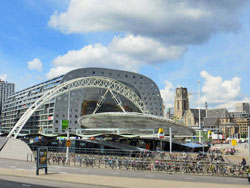 |
|||
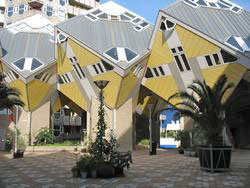 |
The Cube Houses at Blaak are designed to resemble trees, which is why the area is also called the Blaakse Bos (Blaak Forest). One of the houses, the Kijk-Kubus, can be visited inside for a small entrance fee, or you can stay overnight at the Stayokay hostel located within the complex. | |||
| This area is known as the Old Harbour, Rotterdam’s first harbour, built in 1328. Here you’ll find the White House, the Marines Museum, several bar-restaurants, and the historic shipyard Koningspoort, where historic ships are maintained and repaired. | 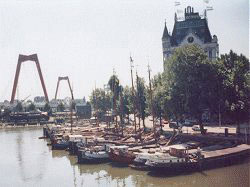 |
|||
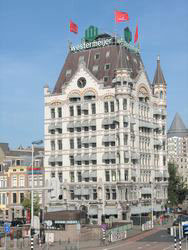 |
Completed in 1898, this building was one of the tallest in Europe at the time and is considered Rotterdam’s first skyscraper. Known as the White House, it features a façade of white glazed bricks adorned with Art Nouveau mosaics and statues. Remarkably, the White House is one of the few buildings in Rotterdam’s city centre that survived the bombing during World War II. | |||
| The famous sculpture 'The Devastated City' by Ossip Zadkine symbolizes the dramatic destruction of Rotterdam’s city centre during the Second World War. It depicts a man raising his hands to the sky in despair as bombs fall, with a gaping hole in his torso representing the heart of the city that was obliterated. | 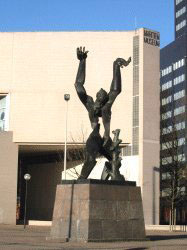 |
|||
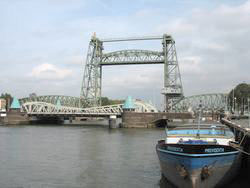 |
The tall bridge you see here is the Hef, a former railway lifting bridge that was in use until 1993. Since the trains now run underground, the bridge is no longer operational, yet the Hef remains one of Rotterdam’s most iconic landmarks. | |||
| View of the Boompjes with the Willemswerf building, where Jackie Chan slid down from the roof in the movie Who Am I. You can watch the scene on YouTube. | 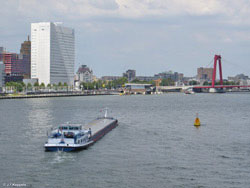 |
|||
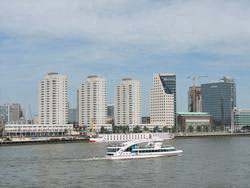 |
Along the Boompjes, you’ll see three apartment buildings. Here, the Nehalennia, a classic passenger ship from 1908, is moored and offers a 1½-hour boat tour through the harbour. A little further, beneath the Erasmus Bridge, you’ll find the Spido, which provides a 75‑minute harbour cruise. However, the Port of Rotterdam is far too large to experience in a short tour. Stretching over 40 kilometres to the North Sea, it takes a full day trip to the Maasvlakte to truly see the entire port. | |||
| The Erasmus Bridge is one of three bridges in Rotterdam spanning the river Nieuwe Maas. It has become one of the city’s most iconic landmarks. From here, you can enjoy a beautiful view of the Cruise Terminal, where cruise ships dock. | 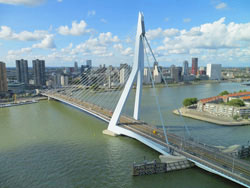 |
|||
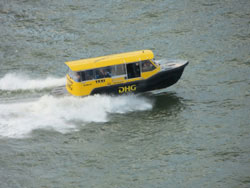 |
This is the Water Taxi, which can take you to various locations along the river, such as Delfshaven, Hotel New York, the steamship SS Rotterdam, the Euromast, the Veerhaven, the Old Harbour, the Water Tower, Feyenoord’s stadium De Kuip, the Zalmhuis restaurant, or simply across to the other side of the river. | |||
| The former arrival and departure hall of the Holland-America Line is nowadays the Cruise Terminal of Rotterdam. The building next to the terminal, known as The Rotterdam, is the largest (though not the tallest) building in the Netherlands. In addition to offices and apartments, it also houses Hotel Nhow with 285 rooms. The hotel’s 'Sunset Rooms' offer stunning views of the Erasmus Bridge, the river, and Rotterdam’s city centre. | 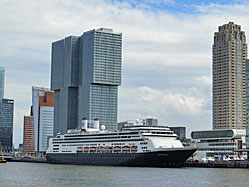 |
|||
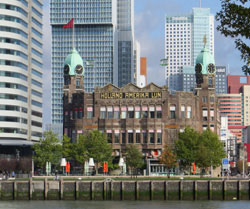 |
Here you see what was once the head office of the Holland-America Line (HAL), now transformed into Hotel New York. Between 1880 and 1925, nearly one million emigrants departed from this location for America. HAL was founded in Rotterdam and operated as a Dutch shipping line between the Netherlands and North America from 1872 to 1989. In 1989, it was taken over by Carnival Cruises and relocated to the USA. For more about HAL’s history, visit the Unofficial Holland America Line website. | |||
| The former ocean liner and cruise ship of the Holland-America Line, SS Rotterdam, was built in Rotterdam in 1959 for HAL. Today, it serves as a museum, hotel, and restaurant, located on the south side of the city. Visiting this historic steamship is one of the must-do experiences in Rotterdam, and you can even stay overnight in one of its hotel rooms. | 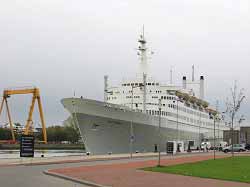 |
|||
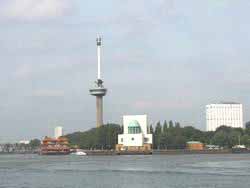 |
Euromast observation tower offers a fantastic panoramic view over Rotterdam, with a brasserie located halfway up. From the observation deck, you can take the Euroscope, which brings you to the very top of the tower at 185 metres. For thrill-seekers, abseiling from a height of 100 metres down to the ground is also possible. In the picture, directly to the right of the tower, you can see the ventilation building of the Maastunnel. Next to it is a small entrance building, where you can descend into the tunnel and cross the river on foot or by bike. | |||
| The flour windmill Distilleerketel is located in the historic district of Delfshaven, a small but charming part of Rotterdam. Close to Delfshaven, near Metro Station Coolhaven (under the bridge), you’ll find Rotterdam ’40-’45, which focuses on the city’s experiences during the Second World War. | 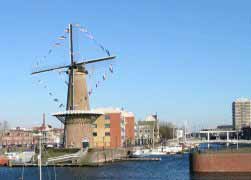 |
|||
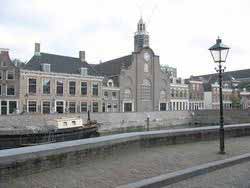 |
Also located in Delfshaven is the Pilgrim Fathers Church, where the Pilgrim Fathers departed on the ship Speedwell for their journey to North America. To the left of the church stands the brewery and restaurant De Pelgrim, where you can book an appointment for a brewery tour. | |||
| Depot and Museum Boijmans van Beuningen, often referred to as the ‘silver flowerpot,’ is the world’s first fully accessible art storage facility. Here, visitors can explore a collection of 151,000 works of art housed in the Depot. The Museum Boijmans Van Beuningen itself is currently closed for renovation until 2028. | 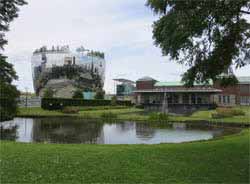 |
|||
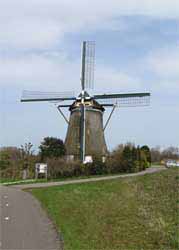 |
There are seven windmills in Rotterdam, though you’ll have to search for them (See the map). Two are located at Lake Kralingen, and the one in this picture is the Prinsenmolen, situated in Prinsemolenpark in Rotterdam-Hillegersberg. Not far from Rotterdam lies Kinderdijk, a beautiful windmill area with 19 windmills clustered close together, two of which are open to visitors. | |||
| Rotterdam Airport is located on the northern edge of the city. Locally known as Airport Zestienhoven, its official name today is 'Rotterdam The Hague Airport', reflecting its proximity to The Hague. The airport offers flights to around 50 destinations across Europe. | 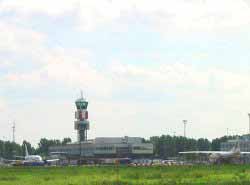 |
|||
Photo Gallery Rotterdam
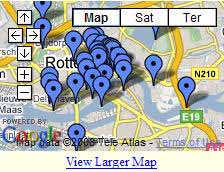
View all the locations in and near to Rotterdam on the map!